Cart 0
NICHOLAS DENTON PROTSACK | COMPOSER-CELLIST

Large Ensemble:

(18 or more instrumentalists)


Height of Land (2026)

for chorus, orchestra, and cello solo - 17’00”
2.2.2.2 | 4.3.3.0 | timp. perc. (3) | chorus (SATB) | 4 tenors (in audience) 4 bassi (in audience)
| violoncello solo (in audience) | 3+ audience soloists (pitched instruments in audience) | strings

Commissioned for the Montreal Symphony Orchestra with the support of the Azrieli Foundation.

Winner of the 2026 Azrieli Commission for Canadian Music.


Across the Vaulted Night (2025)

for symphony orchestra - 9’00”
4.3.3.3 | 5.3.3.1 | timp. perc. (3) hp. (2) | strings

Commissioned by the National Youth Orchestra of Canada.


Erg (2023)

for symphony orchestra - 10’30”
3.2.2.2 | 2.2.2.0 | timp. | strings

Written for the New Zealand School of Music Orchestra.


Murmur from Thin Places (2022)

for string ensemble and piano 4-hands - 10’00”

Commissioned by the Toronto Summer Music Festival.

Winner of 1st prize in the 2023 SOCAN Foundation Awards for Young Composers “Large Ensemble” Award.


Iterations on a Theme by Antonio Salieri (2020)

for oboe, violin, cello and orchestra - 8’30”
0.2.0.1 | 2.2.0.0 | timp. perc. (1) | strings

Commissioned by the Okanagan Symphony Orchestra.

Winner of 1st prize in the 2021 SOCAN Foundation Awards for Young Composers “Large Ensemble” Award.


Vision of a Flaxen Sea (2019)

for symphony orchestra - 9’00”
3.3.3.3 | 4.3.3.1 | timp. perc. (3) hp. (1) | strings

Winner of the James Highsmith Award for Orchestral Composition.
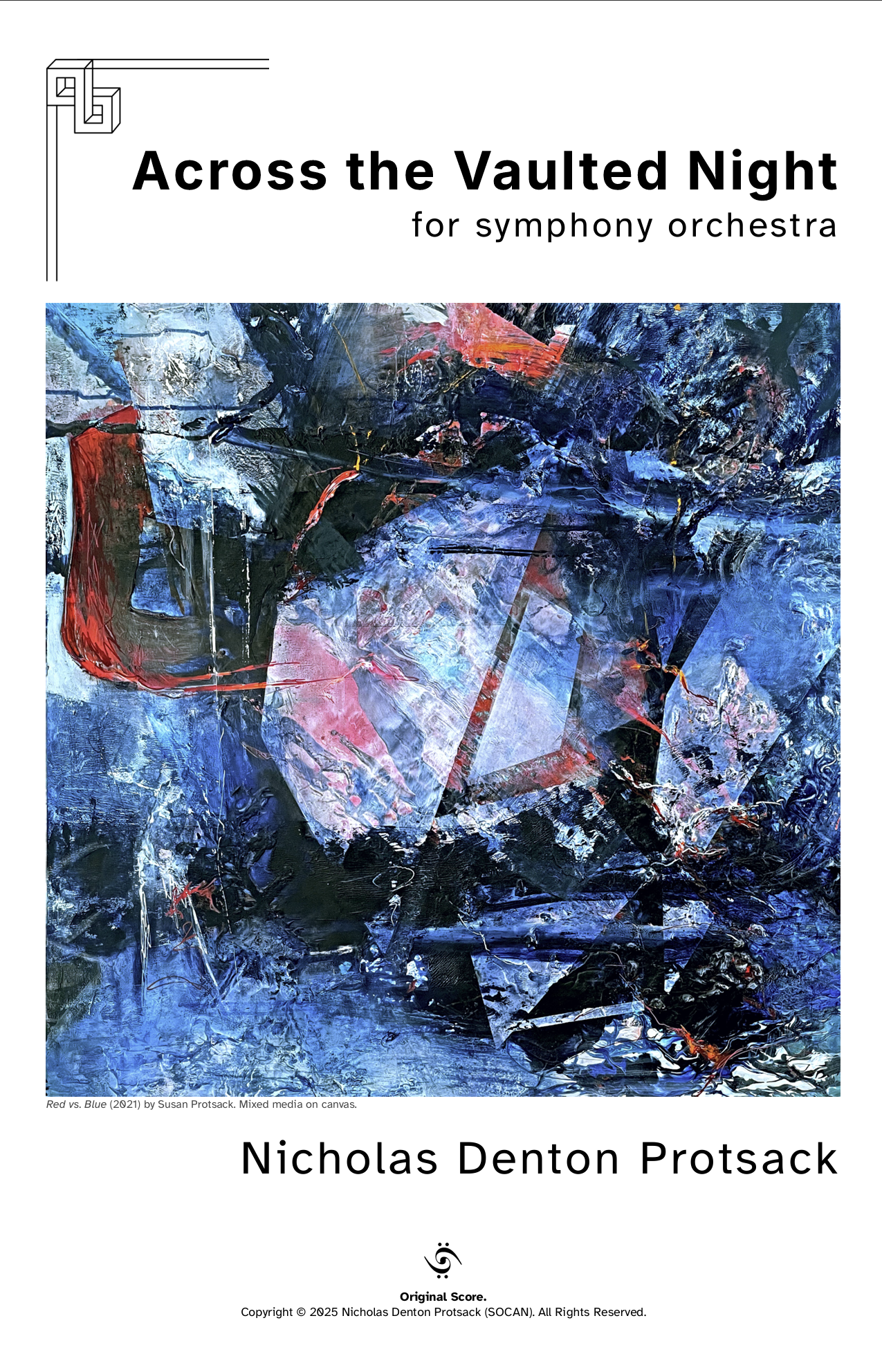


Across the Vaulted Night (2025)

for symphony orchestra - 9’30”

4.3.3.3 | 5.3.3.1 | timp. perc. (3) hp. (2) | strings


It is November 2022. I am standing at a viewing area on the downtown pier of Wellington city harbor to watch a total lunar eclipse. I have been living in New Zealand for just over a week, after relocating from western Canada. Waiting for the eclipse to begin, I gaze at the night sky, which luckily is dazzlingly clear. Orion is the first constellation I recognize, except something about it immediately confuses me: it is upside down. I then turn my attention to the still radiant full moon, studying each of its distinctive craters. It is also clearly upside down. For a moment, I feel an almost dizzying sense of disorientation before realizing that this makes complete sense. I am in the southern hemisphere for the first time; much of this is the night sky that I know, but my point of reference means it is now flipped.
It is May 2024. I am in Kelowna, British Columbia, gazing up at the night sky once again. I am joined by my wife, Kate, and two friends, all of whom are coincidentally from New Zealand. They are not concerned with the fact their night sky has been flipped, however, as we are all instead watching an incredible display of the aurora borealis. The solar storm that triggered this aurora is one of the strongest in decades. As a result, the northern and southern lights are seen across the globe, making international headlines. For several days afterward, I exchange pictures of the aurora with friends from around the world. Although we are separated by continents and oceans, we have all experienced variations of the same virtuosic light show, occurring some hundred kilometers overhead.
The night sky, and especially the liminal region where earth’s atmosphere merges with space, is something that fascinates me. It is a place that exists and expresses itself in terms of intense radiation, temperature, and light. It also has a profound ability to invoke awe—to humbly remind us of our shared location in the cosmos— making what often feels like a very large and complex world seem little more than a point floating through space and time. Nevertheless, just like any other place on and around earth, the presence of humans is readily apparent. Incessantly blinking satellites transmitting incalculable amounts of data, space debris, as well as light and radio spectrum pollution increase in magnitude with each passing year. Across the Vaulted Night (2025) for symphony orchestra, is intended to embody all these aspects of the world above us.

Commissioned by the National Youth Orchestra of Canada and SOCAN Foundation (2025).

If you are interested in performing this work and would like to obtain parts, please send me a message via the ‘Contact’ section of my website.


Across the Vaulted Night - Digital Score
$25.00

For symphony orchestra (2025).

9’30”


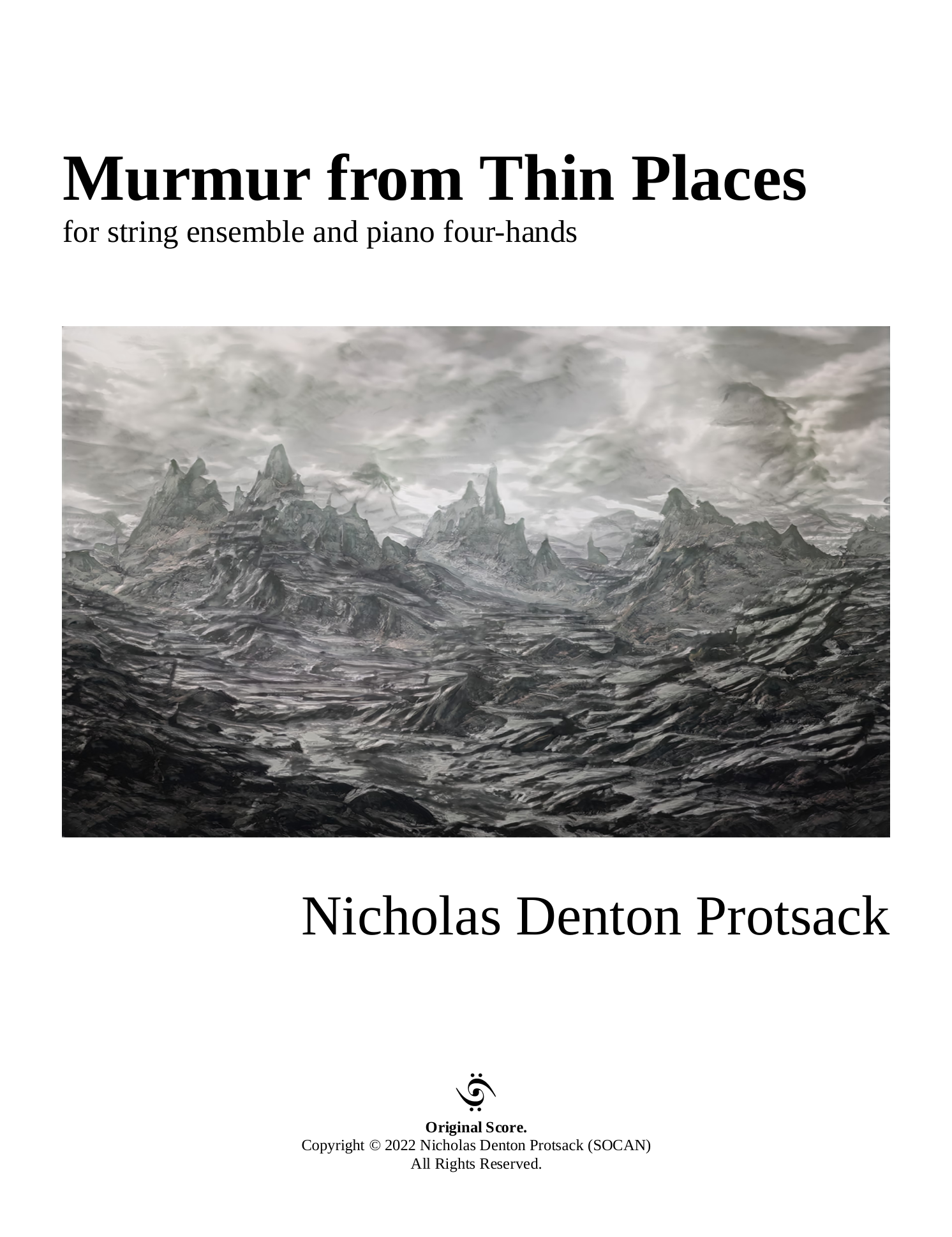
Murmur From THin Places (2022)

for string ensemble and piano 4-hands (10’00”)

6 vln. 4 vla. 4 vlc. pno. (2)


I have been fortunate enough to encounter some environments and landscapes in my life that are inexplicably special. Being physically present in these places has prompted in me a feeling of awe so palpable, it has sometimes felt like a whispered message. To some, places like these are known as 'thin places': places where invisible barriers between the everyday world we experience and another, supernatural world are thin. While my personal belief of what these places are differs in some respects, the concept of thin places intrigues and resonates with me; they do seem to exert an otherworldly force upon those who experience them. Murmur from Thin Places (2022), for string ensemble and piano four-hands, explores the characteristics of these places, the unique feelings of awe they inspire, and the indelible mark they leave on both conscious and unconscious memory.

Performed by the Toronto Summer Music Festival Chamber Music Fellowship, July 2022.

Commissioned by the 2022 Toronto Summer Music Festival.

If you are interested in performing this work and would like to obtain parts, please send me a message via the ‘Contact’ section of my website.


Murmur From Thin Places - Digital Score
$25.00

For string ensemble and piano 4-hands (2022).

10’00”

If you are interested in performing this work and would like to obtain parts, please send me a message via the ‘Contact’ section of my website.


Vision of a flaxen Sea (2019)

for symphony orchestra - 9’00”

3.3.3.3 | 4.3.3.1 | timp. perc. (3) hp. (1) | strings


A faint breeze transforms into a gale; the sound of a million rustling blades of dry grass accompany it. You open your eyes, and a landscape of golden hills—boundless as the sea—stretches before you. The hills begin—slowly at first—to churn in the wind, as if they really were waves upon a sea. They roll, cascade, tumble, and swell, until they reach colossal heights, merging with the blue, marbled sky.

Vision of a Flaxen Sea is a work for symphony orchestra that is inspired by numerous dreams, experiences, and works of art that concern the subject of hilled landscapes—particularly those that are swept by wind, and covered with dry grass or straw. In my mind, these landscapes, dreams, and works of art have a very literal musical quality to them. The aim of this work is to communicate that quality.

Winner of the James Highsmith Award for Orchestral Composition (2019).

If you are interested in performing this work and would like to obtain parts, please send me a message via the ‘Contact’ section of my website.


Vision of a Flaxen Sea - Digital Score
$25.00

For symphony orchestra (2019).

9’30”

If you are interested in performing this work and would like to obtain parts, please send me a message via the ‘Contact’ section of my website.